Jaecoo J8 SHS Review: Seven Seats, Three Motors and a Diff Lock for Under $60K
- 315 kW tri-motor AWD and a rear diff lock for $59,990
- Premium cabin with massage seats, HUD and 12-speaker Sony audio
- Huge second row and strong 70 kW DC fast charging
- Third row is strictly for kids
- Firm front seats and a grainy 360-degree camera
- Accelerator hangs on briefly after you lift off
Seven seats. Three electric motors. 315 kW and a rear diff lock. All for $59,990 plus on-roads.
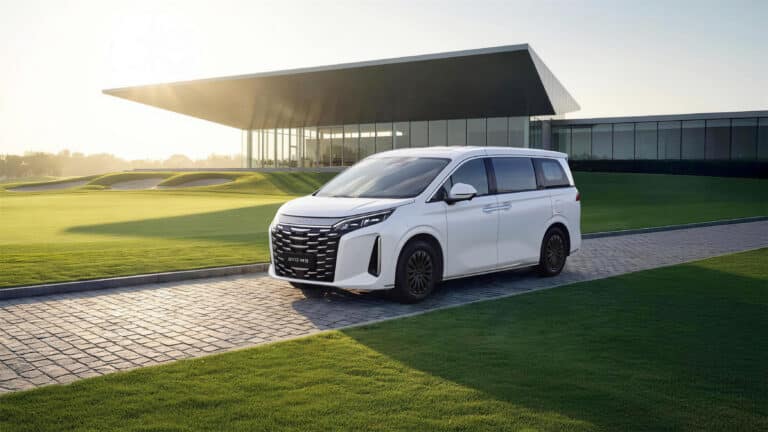
The Jaecoo J8 SHS is the brand’s first seven-seater in Australia and the new flagship of the J8 range. It’s also the only new energy vehicle under $60,000 with a rear differential lock. That one inclusion tells you exactly where Jaecoo sits in the Chery family: the brand for buyers who might actually leave the bitumen.
I spent a few days with the J8 Summit SHS, ran it through a DC fast charge test and a USB port test, climbed into all three rows and put plenty of kilometres on it. Here’s how it stacks up.
Size and dimensions
The J8 SHS measures 4,820 mm long, 1,930 mm wide and 1,715 mm tall, riding on a 2,820 mm wheelbase. The BYD Sealion 8 is roughly 5 to 10 cm bigger in each direction, so the Jaecoo is the slightly more compact of the two.
It sits on 20-inch alloys wrapped in 245/50 R20 Michelin e-Primacy tyres. Suspension is MacPherson struts up front and a multi-link rear, with Continuous Damping Control standard. Ground clearance is 162 mm.
Towing is rated at 1,600 kg braked and 750 kg unbraked, with a 75 kg towball download.
Price and warranty
There’s one SHS grade, the Summit, and it sits at the top of a J8 range that otherwise runs a five-seat, 2.0-litre turbo petrol layout.
| J8 Track | J8 Ridge | J8 Summit SHS | |
|---|---|---|---|
| Powertrain | 2.0L turbo petrol | 2.0L turbo petrol | 1.5L turbo PHEV, three motors |
| Drive | FWD | AWD | AWD |
| Power / torque | 183 kW / 385 Nm | 183 kW / 385 Nm | 315 kW / 580 Nm |
| Seats | 5 | 5 | 7 |
| Price | $49,990 drive-away | $54,990 drive-away | $59,990 before on-roads |
The SHS undercuts the Omoda 9 sold in the same showrooms by $2,000 and matches the price of the Chery Tiggo 9 Ultimate Super Hybrid it shares its driveline with.
Ownership is covered by an eight-year, unlimited-kilometre vehicle warranty and a matching eight-year, unlimited-kilometre high-voltage battery warranty. You also get eight years of capped-price servicing and up to eight years of roadside assistance, renewed each time you service with a Jaecoo dealer.
Powertrain
Pop the bonnet and you’ll find a 1.5-litre turbocharged petrol engine making 105 kW and 215 Nm. It works with two electric motors on the front axle, rated at 75 kW/170 Nm and 90 kW/220 Nm, and a third motor on the rear axle producing 175 kW and 310 Nm. Drive to the front wheels runs through a three-speed dedicated hybrid transmission for extra torque multiplication.
Combined output is 315 kW and 580 Nm. That’s enough to get this big seven-seater from 0-100 km/h in 5.8 seconds.
It’s the same tri-motor Super Hybrid driveline as the Chery Tiggo 9, which I broke down in detail in my review of that car. The difference is at the back. Jaecoo has fitted an electronically actuated mechanical locking differential to the rear axle, plus Snow, Sand and Off-road drive modes and hill descent control.
Energy comes from a 34 kWh NCM battery under the cabin floor and a 70 L fuel tank that wants 95 RON. Jaecoo claims 169 km of electric range and more than 1,000 km combined, both on the NEDC cycle. NEDC is the most generous test going, so plan on a fair bit less in the real world.
Charging
AC charging tops out at 6.6 kW. DC fast charging is rated at up to 70 kW, which is strong for a plug-in hybrid, so I took it to a 125 kW Ampol AmpCharge site to test the claim.
I plugged in at 32 per cent and it opened at 47.6 kW. A couple of minutes later, with the battery warmed up, it jumped to 62.8 kW at 37 per cent and held there. Start from a lower state of charge and I reckon it gets to the full 70 kW. Jaecoo quotes 25 minutes for 30 to 80 per cent.
Interior
Open the door and the J8 makes a strong first impression. Quilted leather on the seats and door cards, a suede-style lining across the top of the dash, ash-coloured faux woodgrain below it and a satin bronze beltline under that. At night the dark blue ambient lighting picks up the bronze and it looks really sharp. The suede top also stays cool in the sun, which counts for a lot in an Australian summer.
Ahead of the driver is a 12.3-inch digital cluster with plenty of customisation and a small but useful head-up display. A second 12.3-inch screen handles infotainment with wireless Apple CarPlay and Android Auto, DAB radio and Hello Jaecoo voice control. Sound comes from a 12-speaker Sony system, including speakers built into the driver’s headrest. The 360-degree camera has a 3D view and plenty of angles, but the image is grainy with jagged edges on straight lines.
Physical controls are well covered. There’s a proper headlight switch, which is going missing in too many new cars, a column shifter, three manually adjusted centre vents, a volume rocker and dedicated EV and HEV mode buttons. You also get a 50 W wireless charger, a vented centre console and a built-in fragrance dispenser that feeds through the air conditioning.
The front seats are heated, ventilated and massaging, with power lumbar and a thigh extension for the driver. They’re also firm. A massage function means a block of foam has to go, and you feel it. If you like a firm seat you’ll be happy. I’m a soft seat person.
My one styling gripe is the dashboard. It’s the split-screen layout shared with the Tiggo 9, rather than the waterfall-style centre screen that gives the J5 and J7 their identity. The J8 deserves its own look.
USB charging test
I tested every USB port in the first two rows. The rear ports win, which is unusual.
| Port | Front | Second row |
|---|---|---|
| USB-C | 20 W | 25 W |
| USB-A | 6 W | 14 to 15 W |
Second and third rows
Second-row legroom is enormous. The floor is a little high, so your knees sit up, but there’s so much room to stretch out under the front seat that it doesn’t matter. The seat feels firm at first touch then gives a little as you sink in, and it’ll be comfortable on long drives. At 178 cm I had about four fingers of headroom under the panoramic sunroof.
Rear passengers get their own vents and climate controls, heated and ventilated outboard seats, window shades, privacy glass and windows that drop all the way down. ISOFIX points are on the outboard seats, with top tethers on all three.
The third row is a different story. Access is from the driver’s side only, and you need to slide the second row forward to free up any legroom. At 178 cm my head was touching the roof. Kids and small teens will be fine. An adult could manage 5 to 10 minutes. Each side gets a cup holder, phone holder and reading light.
One practical note: the second row centre headrest blocks most of the view through the rear-view mirror. Pull it out if you don’t need it.
Boot space
With all three rows up there’s 200 L, measured to the roof. Fold the 50:50 third row and that grows to 738 L. There’s a 12 V outlet and a boot light, but no meaningful underfloor storage, just a spot for the warning triangle.
Drop the 60:40 second row as well and you get a wide, flat load space that will swallow a lot of gear.
On the road
The first word that comes to mind is powerful. This thing is a rocket. Three motors and that three-speed transmission make a big seven-seater feel effortless, and overtaking on the highway is no issue at all. I love this driveline, and it suits a vehicle of this size perfectly.
There is a calibration issue with the accelerator. Response is a fraction slow off the mark, and after a hard squeeze the car keeps pushing for around half a second once you lift off. It’s the kind of thing Jaecoo should be able to fix with a software update.
Steering is direct with a small dead zone on centre. I’ve not been a fan of Michelin’s e-Primacy in the past, since its harder EV compound doesn’t grip like the regular Primacy. Here it works. No traction loss under full throttle, even in the wet. In Sport mode the CDC suspension rides firmly with plenty of road feel and keeps the body well controlled for a car this big.
Driver assistance is livable. The speed sign chime is the most frequent alert, and driver monitoring is well calibrated, triggering only once across the whole drive. Lane keeping holds on the freeway but gets vague through corners, so keep your hands where they should be.
Safety kit runs to 10 airbags, including a front centre airbag and a driver’s knee airbag, plus AEB, blind spot monitoring, rear cross-traffic alert and door opening warning. The J8 is yet to be tested by ANCAP.
Where it fits
The J8 SHS goes up against the BYD Sealion 8, the Chery Tiggo 9 and the Omoda 9. It’s the only one of them with a rear diff lock. Below $60,000, no other new energy vehicle offers one, and you have to spend considerably more to find a plug-in SUV that does.
It’s not a hardcore four-wheel drive. Road tyres and 162 mm of clearance see to that. But as a family hauler that can tackle beach tracks and fire trails with more confidence than anything else at this price, it’s a genuinely unique proposition.
If Jaecoo sorts that throttle calibration, the J8 SHS becomes the seven-seat plug-in hybrid to beat for families who like the idea of a weekend off the beaten track.